
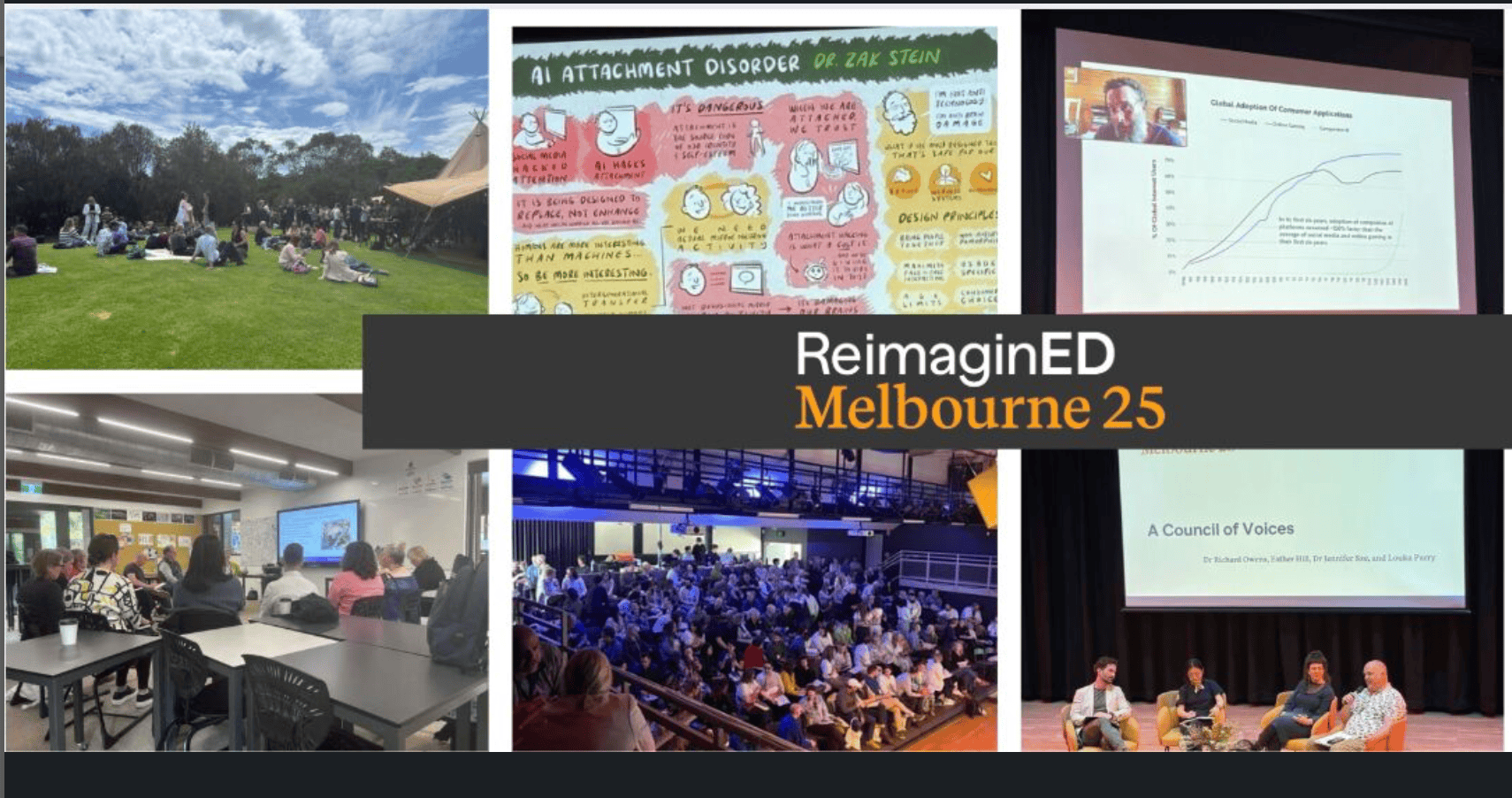
Reflections from ReimaginED25 Melbourne
ReimaginED
ReimaginED is a unique nomadic festival of learning dedicated to exploring and shaping the emerging futures of education. With its origins on Mornington Peninsula in Australia, this dynamic event has evolved into a global movement, traveling to innovative educational hubs across the Asia-Pacific region. Each gathering creates a vibrant, participatory space that invites educators, students, researchers, artists, community leaders, and activists to engage in transformative dialogue, collaboration, and co-creation.
Reflections
ReimaginED has become the ‘highlight’ professional learning event for me since its inception. The provocations at this year’s event were significant and challenging. However, what made them not just ‘provoke’ and then let it slide off or shove it away in my back pocket, were the conditions which were created to deeply engage, to make sense of them, to discuss, explore and to take action.
Story telling continues to be a powerful medium for communication at this event. We were provided time and structures to connect to the story and how it related to our story of self, the story of us, and the story of what happens now.
There was significant interconnection between the provocations, workshops and master classes which deepened our understanding and engagement.
Day 1 began with powerful provocations from Woodleigh School student Charlie Russo and Professor Mary Helen Immordino-Yang, EdD (watch the YouTube clip on ‘all learning is social and emotional’) that challenged us to think deeply about the experience of young people growing up in today’s world, the purpose of learning and the opportunity to focus more deeply on human development. Their insights sparked conversations that carried into diverse and engaging breakout sessions where ideas flowed, and perspectives collided in the best possible way.
Dr Dominique Hes closed the day with a provocation around the role education might play in helping to regenerate our communities, places, and social-cultural systems. As always, the time to connect, to share dialogue that mattered, to enjoy good food, and relax in the beautiful bushland setting of the school were central to the experience.
Day 2 started with Zachary Stein inviting us into a critical conversation about AI Attachment Disorder, the dangers of anthropomorphism, the potential for the ethical use of AI to transform education, and the importance of safeguarding human development.
Most of the day was given over to an incredible range of breakout sessions and masterclasses exploring innovation in fields such as play-based learning, youth activism, systemic wellbeing and competency-based assessment.
Professor Melitta Hogarth (PhD) brought the power of slam poetry to the stage, challenging the audience to engage with the hard work of decolonising institutions and reminding us that true allyship means taking responsibility and leaning into discomfort. Her provocation concluded with a focus on the Ngarrngga project – an initiative to embed Indigenous knowledge in curriculum and transform teacher education across Australia.
The day closed with the Council of Voices and the chance to hear from Esther Hill, Dr. Jennifer Sze PhD, and Louka Parry, bringing diverse, authentic, and heartfelt response to the question, ‘What are the three most important things humans can learn today?’.
What I noticed this year, was the interconnection between participants is strengthening, and a wave of action is building momentum regarding education for human and ecological flourishing.
There was significant interest in the workshop I facilitated on Day 2, from researchers, university academics, principals and teachers, which focused on a ‘Living Systems approach to Change’. Each person was able to share what it was that they were wanting to ‘grow’ identifying growing actions and at the same time limiting constraints. All of them enjoyed hearing ‘our LESNW story’ which identifies the characteristics of a living systems approach grounded in Growing Deep, Interdependence (better together), Emergence (creating the conditions for innovation), Diversity (Nurturing adaptation and resilience) and Compassion (the pathway to regeneration).
It was an incredibly regenerative experience, bringing further clarity, commitment, and responsibility to create the conditions for us to become Free to Flourish and to become, as the principal of the Friends School Ester Hill shared, “angelic troublemakers” (Bayard Rustin).
I have also returned from this event filled with hope that this is not something we are doing on our own but as part of a thriving network within LESNW and the wider network of Lutheran schools and learning communities within and beyond Australia which share a common vision.

Lutheran Education SA, NT and WA